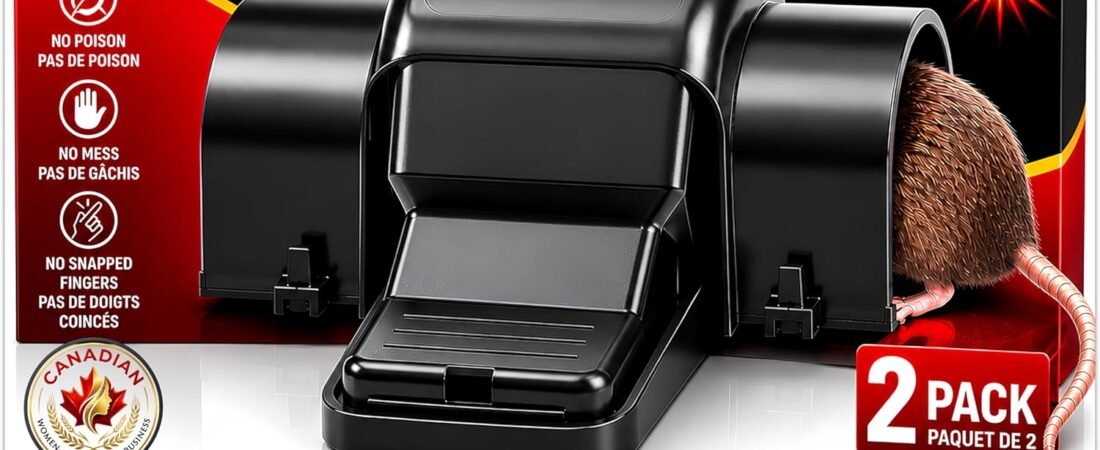
How to Choose the Best Outdoor Rat Trap (2026 Buyer’s Guide)
If you have rats outside your house, picking the wrong trap is worse than doing nothing. Glue boards catch your dog’s paw before they catch a rat. Poison kills owls and raccoons and your neighbour’s cat. Old wooden snap traps misfire in the rain and snap fingers when you re-set them. This guide cuts through the noise.
You will leave this page knowing exactly which type of trap to buy, how many to start with, how to place them, and what to avoid. Written by the team at Zivaska, a Burnaby BC company that ships rat traps across Canada.
The four types of rat traps
Every outdoor rat trap on the market falls into one of four categories. Most buyers get talked into the wrong one. Here is the honest comparison.
| Type | How it works | Best for | Avoid if |
|---|---|---|---|
| Snap trap (enclosed, reusable) | Spring-loaded bar inside a plastic tunnel. Catches in 0.5 seconds. | Almost everyone. Outdoor, indoor, homes, businesses. | You want zero kill (use live trap instead). |
| Snap trap (open, wooden) | Classic Victor-style bar trap. Open bait pedal. | Cheap, single use, mouse-only situations. | You have pets or kids, or it will rain. |
| Glue board | Sticky tray. Rat steps on, gets stuck, dies of stress or dehydration. | Indoor monitoring in commercial settings. | Outdoor use, ethical concerns, pets nearby. Loses tack in rain. |
| Poison bait | Anticoagulant pellets in a bait station. Rat eats, dies in 3 to 7 days. | Almost no one anymore. Banned or restricted in many jurisdictions. | Pets, kids, wildlife, food premises. Banned for general use in BC. |
| Live trap | Catches alive for release. | Ethical buyers who can relocate animals. | You have ongoing infestation, or no legal release site. |
The winner for almost every buyer in 2026 is the enclosed reusable snap trap. It catches fast, it is safe around pets and kids, it works in rain and snow, and the cost-per-catch beats every other option once you reach the third or fourth rat.
Snap traps: what to look for
Not all snap traps are equal. Use this checklist before you buy.
1. Enclosed dual-tunnel design
The strike bar must be inside a tunnel that a dog, cat, raccoon or curious kid cannot reach into. Open-pedal wooden traps fail this test. The Zivaska dual-tunnel design has two entry points so the rat enters in line with the strike bar, and the bar itself is enclosed.
2. Snap force of 40 lb or higher
Rats are tougher than mice. A snap force below 40 lb gives you injured-but-alive catches, which is messy and inhumane. Look for 45 lb hardened steel spring or stronger.
3. Snap speed under 1 second
0.5 seconds is the benchmark for the fastest reusable traps. Anything slower gives the rat time to react.
4. Weather rating
Check the body material (impact-resistant ABS is the standard), the hinge (corrosion-resistant steel), and the spring (hardened steel that does not rust). If the product page does not mention weather rating, assume it does not have one.
5. Reusable rated for hundreds of catches
Single-use snap traps look cheap on the shelf and cost three times more over a season. A reusable trap should be rinse-and-reset, take under 10 seconds to re-bait, and last hundreds of catches without spring fatigue.
6. Ships from Canada
If the trap ships from a warehouse in China or the US, you wait 2 to 4 weeks and pay duties. Ordering from a Canadian supplier means next-day or same-day delivery and no customs surprises.
Three rat traps to avoid
I am going to be direct. Three popular categories are bad buys in 2026.
- Cheap multi-pack open snap traps from generic marketplaces. Wooden Victor-style traps with no enclosure. They misfire, hurt pets, and fail in rain. The $0.99 per trap math looks great until your dog needs a vet visit.
- Glue boards. Banned in some jurisdictions. Considered inhumane by the Canadian Federation of Humane Societies. Outdoors they last 2 rains before they are useless. Indoors they are a liability with pets.
- Second-generation anticoagulant rodenticides (SGARs). Restricted in BC since 2023. Implicated in the deaths of raccoons, owls, hawks and family pets across the Pacific Northwest. If you are still buying these, switch.
How many traps do you need
This is the question we get every day. Here are the numbers we recommend based on thousands of Canadian customers.
| Situation | Starting quantity |
|---|---|
| One or two sightings, garage or shed | 2-pack |
| Active rats, multiple droppings, single property | 4-pack |
| Basement, attic and crawl space all affected | 4 to 6 traps |
| Restaurant or commercial kitchen | 6 to 10 traps |
| Warehouse or large barn | 10 to 25 traps |
| Property manager, multi-building portfolio | 50+ (bulk pricing) |
Under-buying is the single most common mistake. Two rats turn into ten in eight weeks. Start with more traps than you think you need. They are reusable, so they pay back across future seasons.
Where to place them outdoors
Trap placement matters more than trap brand. Read our full guide on rat trap placement outdoors, but the short version is this. Rats are wall-followers. They never run across an open lawn. Place traps directly along walls, fences, baseboards and rodent runways with the entrance facing along the wall, not perpendicular to it.
The five highest-success outdoor placements:
- Along the foundation wall under a deck
- Behind garbage bins or against the bin enclosure wall
- Along fence lines, especially at corners
- Inside shed corners, against the wall
- Along laneway baseboards near compost or chicken coops
The best bait (and what does not work)
Peanut butter beats everything else, by a wide margin. We have tested every common bait across thousands of customer reports. The ranking, best to worst:
- Peanut butter (best, year-round)
- Bacon, small piece (excellent in summer)
- Salami or pepperoni (good)
- Dog food kibble (good)
- Apple chunks (decent in summer)
- Cheese (mediocre, contrary to cartoons)
- Chocolate (mediocre)
- Bread, crackers, granola (poor)
Use a small dab. Over-baiting lets the rat steal bait without triggering the plate.
Weather, pets, kids and other Canadian realities
Outdoor traps in Canada have to survive coastal rain, prairie cold and Ontario humidity. Pick a trap with an ABS body and a hardened-steel hinge. Avoid anything with exposed wood or untreated metal parts.
If you have pets, the only safe option is an enclosed tunnel trap. Open snap traps account for the majority of veterinary trap injuries every year. Glue boards are arguably worse.
If you have kids under 8, place traps in spaces kids cannot reach, even if the trap is enclosed. Garage corners, under decks, in sheds. Better safe than sorry.
What is legal in BC and across Canada
British Columbia restricted second-generation anticoagulant rodenticides in 2023. Quebec and parts of Ontario followed with their own rules. Snap traps (enclosed or open) are legal everywhere. Glue traps are restricted or banned in some municipalities.
For commercial food premises, every Canadian health authority (Fraser Health, Vancouver Coastal Health, Toronto Public Health, Montreal DSP) prefers no-poison snap traps near food preparation areas. Many inspectors call out no-poison programs as best practice.
Skip the guesswork.
Order the trap that meets every criterion in this guide.
Shop Zivaska Outdoor Rat Traps âFAQ
Are reusable snap traps better than disposable?
Yes, by a wide margin. Cost-per-catch is lower, you are not throwing out plastic with every catch, and the reusable mechanism is built to last.
Are sticky traps or snap traps better for outdoor use?
Snap traps, every time. Sticky traps lose adhesion in rain after one or two storms. They also pose a risk to non-target animals.
Do I need to wear gloves when handling a trap with a catch?
Yes. Use disposable nitrile gloves. Open the trap directly over a garbage bag, tie the bag, dispose, then rinse the trap with hot water.
How long should I keep traps out after I catch a rat?
Keep them set for at least 14 days after the last catch. Rats live in groups. One catch usually means more nearby.
What if I have rats but also outdoor cats?
Place enclosed snap traps inside locked bait stations (we sell these) or in spaces cats cannot access. Never use poison or glue boards anywhere cats can reach.