SHIPS FROM BURNABY, BC
NO POISON
How to Get Rid of Rats: Traps, Bait, Placement, and Safety
A practical, no-nonsense guide to catching rats, whether you’re dealing with an outdoor yard problem, a garage or basement infestation, or a large rat that keeps avoiding cheap traps. Covers trap types, bait, placement, pet and child safety, and what actually works.
Which Trap Type Actually Works
Three designs dominate the rat trap market: the classic open snap trap, the enclosed snap trap, and the enclosed tunnel trap. Each catches rats differently, and the differences matter more than most packaging admits.
| Trap type | How it works | Reusable | Contact risk | Best for |
|---|---|---|---|---|
| Open snap trap | Exposed spring bar snaps down on contact with the trigger | Yes | Higher, exposed mechanism | Budget, occasional single mouse |
| Enclosed snap trap | Same spring mechanism, housed in a plastic shell with an entry slot | Yes | Lower, shell limits contact | Homes with some pet or child concern |
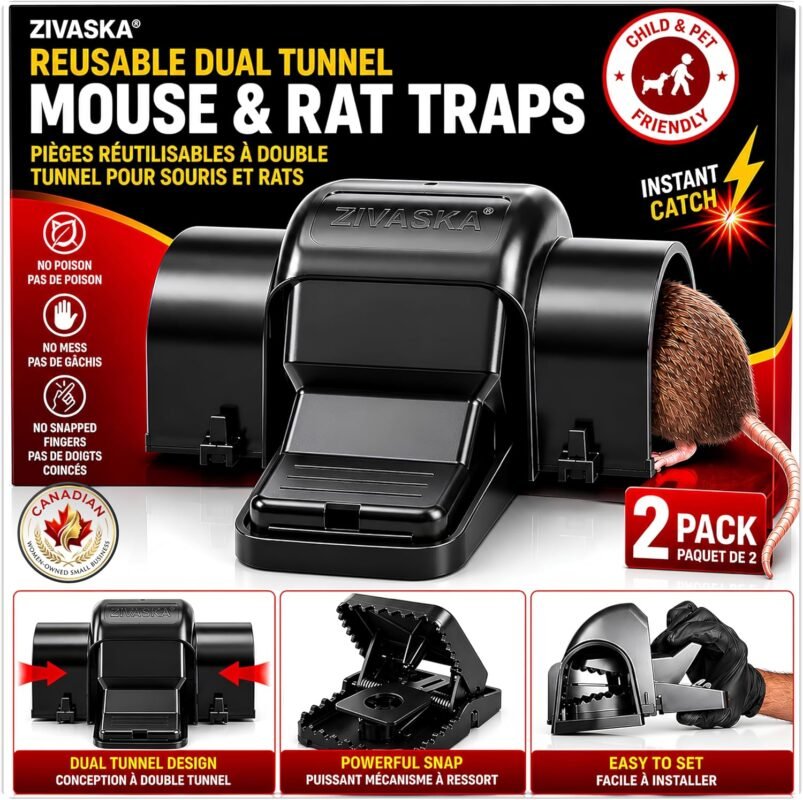
| Enclosed dual-tunnel trap | Two entry tunnels lead to an internal trigger inside a sealed housing | Yes | Lowest, no exposed parts | Rats, larger mice, homes with pets or kids, repeat use |
| Glue board | Adhesive surface traps the rodent on contact | No, single-use | Direct contact required to remove | Insects and small mice, not ideal for large rats |
| Rodenticide (poison) | Rodent ingests bait, dies later, often out of sight | No | Risk to pets, kids, wildlife | Severe infestations under professional guidance |
For rats specifically, and for large house mice, an enclosed dual-tunnel trap tends to outperform a basic open snap trap for two reasons: the two entry points give the rat more than one approach angle, and rats are naturally cautious of open, exposed objects in their path. A tunnel shape reads as cover, not a hazard, which is part of why enclosed tunnel designs see better catch rates on rats that have already learned to avoid a plain snap trap.
Choosing the Right Trap for the Rat
Do I need a bigger trap for a big rat?
Yes. A trap sized and weighted for mice often won’t have the trigger sensitivity or spring force needed for a full-grown Norway rat, which can weigh 200 to 510 grams, or a roof rat at 140 to 285 grams. A trap needs roughly 24 grams or more of trigger load to avoid false-triggering on debris while still reliably catching an adult rat.
Can a mouse trap catch a rat?
Sometimes it will trigger, but a mouse-sized trap is rarely strong enough to fully contain a large rat, which often escapes injured, making the problem worse. Match the trap to the rodent.
Will a rat trap work on small mice?
Not always. A trap built with a higher trigger load for rats may not respond to a very light mouse. If you’re dealing with small house mice specifically, look for a trap rated for that lighter weight range rather than a rat-focused design.
Ready to stop guessing and start catching?
The ZIVASKA Reusable Dual Tunnel Rat Trap is built for exactly what this guide covers: enclosed design, dual entry, no poison, indoor or outdoor use.
Where to Place Traps
Rats and mice travel along edges. They rarely cross open floor space if they can avoid it, since exposure to predators is a real risk in their instinct. This single fact drives almost all effective trap placement.
Should traps go along walls?
Yes, always. Place traps flush against walls, in corners, and along any edge where you’ve seen droppings, gnaw marks, or grease trails.
Where should I place traps in a garage or basement?
Along the perimeter walls, near any gaps around pipes or vents, and behind stored boxes or equipment where rodents can travel undisturbed.
Where should I place traps in a kitchen?
Behind and beside appliances like refrigerators and stoves, under cabinets, and along the base of walls, anywhere a rodent could travel without crossing open floor.
How many traps do I need?
For a single confirmed problem area, start with 2 to 4 traps spaced a few metres apart along the travel route. For a larger property, garage, or warehouse, more traps spread across multiple routes will catch faster than a few traps in one spot.
How far apart should traps be?
Roughly every 3 to 6 metres along an active route is a reasonable starting spacing, closer together near a confirmed nest or heavy activity area.
Best Bait and Baiting Technique
What’s the best bait for a rat trap?
Peanut butter is the most consistently effective bait, it has a strong scent, rats can’t easily grab and run with it, and it doesn’t dry out as fast as bread or cheese.
How much bait should I use?
A small amount, roughly the size of a pea, pressed into or onto the trigger area. Too much bait lets a rodent feed without fully engaging the trigger.
Should I pre-bait traps before setting them?
For cautious or trap-shy rats, leaving bait out unset for a few days lets them feed without risk, building confidence before you actually set the trap. This single step often makes the difference with rats that have avoided traps before.
Why is the rat eating the bait but not triggering the trap?
Usually too much bait was used, letting the rodent feed from a safe distance, or the bait was placed in front of the trigger rather than on or past it.
Why Rats Avoid Traps
Are rats smart enough to avoid traps?
Rats are naturally cautious of new objects in their environment, a behaviour called neophobia. It’s not that they “understand” a trap, they’re wary of anything unfamiliar, which can look like avoidance.
Can rats smell humans on traps?
Rats have a strong sense of smell and can detect human scent on a trap. Wearing gloves while setting or handling traps reduces this.
Why did the rat suddenly stop going near the trap?
If a rat narrowly escapes a trap or witnesses another rat get caught, it will often avoid that location and any similar object nearby for some time. Moving the trap slightly or switching to an enclosed design can help.
Safety Around Pets and Kids
No mechanical trap is fully pet-proof or child-proof, but design differences matter. Enclosed traps, especially tunnel designs, put a housing between the trigger mechanism and anything reaching in from outside, which meaningfully lowers accidental contact risk compared to an open snap trap.
Are enclosed traps safer than open snap traps?
Yes, by design. The trigger sits inside a shell rather than exposed on top, reducing the chance of a curious pet or child making direct contact.
How do I keep pets away from traps?
Place traps in areas pets can’t access, behind furniture, inside cabinets with a gap, or behind barriers, in addition to using an enclosed design.
Should traps be placed where children can reach them?
No. Regardless of trap design, place traps out of reach of children, in areas like garages, basements, or behind appliances they wouldn’t normally access.
Traps vs. Poison
Is a trap better than rat poison?
For most home situations, yes. Traps give an immediate, visible result. Poison works over days, and a poisoned rat commonly dies inside a wall or void, causing odour that’s difficult to trace and remove.
Is poison-free rat control effective?
Yes, when traps are placed correctly and in enough numbers for the size of the problem. Mechanical traps also avoid the secondary poisoning risk to pets, wildlife, or other animals that might eat a poisoned rodent.
Outdoor-Specific Tips
Where should outdoor traps go?
Along fence lines, near sheds, under decks, and around garbage or compost areas, anywhere rodents have consistent cover and a food source.
Does rain affect a trap?
Water can affect bait freshness and, for some designs, the mechanism itself. A weather-resistant, rust and rot-proof housing matters for anything left outdoors for extended periods.
Should outdoor traps be covered or sheltered?
Placing traps under natural cover, next to structures, under bushes, along fences, both protects the trap and matches where rodents already prefer to travel.
Indoor-Specific Tips
Where do rats hide indoors?
Behind and under large appliances, inside wall voids, in basements and crawl spaces, and inside stored boxes or clutter in garages.
How many traps for an indoor problem?
Start with traps at every confirmed entry or travel point, commonly baseboards, behind the fridge, and along basement walls, then adjust based on activity over the first week.
Quick Answers
Which type of rat trap is most effective?
For rats and larger mice specifically, enclosed dual-tunnel traps generally outperform basic open snap traps, since the enclosed design overcomes a rat’s natural caution of exposed objects.
Are reusable traps worth it over disposable ones?
For an ongoing or recurring rodent problem, yes. A reusable mechanical trap costs more upfront than a glue board but pays for itself after a few uses and produces less ongoing waste.
What’s the difference between a mouse trap and a rat trap?
Primarily trigger sensitivity and spring force. Rat traps need a higher trigger load and stronger mechanism to reliably catch and contain a larger rodent.
How long does it typically take to catch a rat?
With correct placement and bait, often within a few days to a week. If nothing happens after a week, move the trap to a different section of the same travel route.
Can I use the same trap indoors and outdoors?
Yes, provided the housing is weather-resistant. A trap built for outdoor use will generally hold up fine indoors too.
Do I need gloves when handling traps?
It’s good practice, both to reduce human scent on the trap and for hygiene when emptying and resetting it.
Ready to stop guessing and start catching?
The ZIVASKA Reusable Dual Tunnel Rat Trap is built for exactly what this guide covers: enclosed design, dual entry, no poison, indoor or outdoor use.